ESG

Green Bonds

Focusing on the development of low-carbon energy and energy services that enable its customers to reduce their carbon footprint, the Group is firmly committed to contributing to the emergence of the green bond market, which is proving to be one of the most promising investment options in the future to finance the energy transition.

1. Group's emissions history

Paragraph content

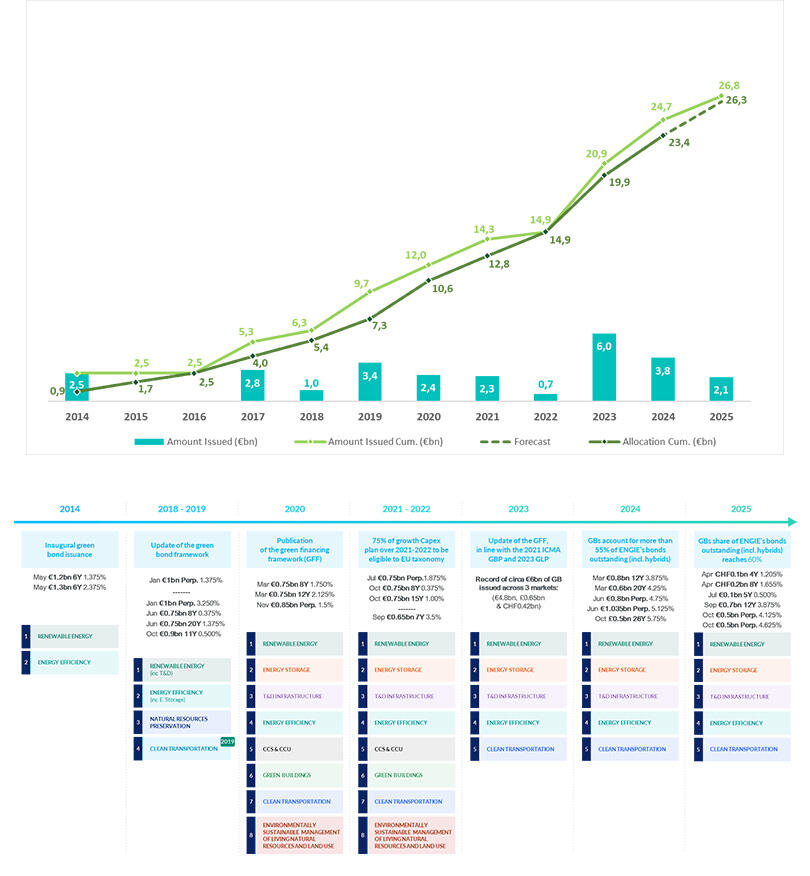
Green bonds are conventional debt instruments: they are bearer securities, generally listed on a regulated market and with the same level of recourse as the borrower's other senior creditors. Their special feature relates to the use of the funds raised; the proceeds of these loans are intended to be invested exclusively in so-called "green" projects, generating climate and/or other environmental benefits, and also meeting social and societal criteria. ENGIE issued its first green bond in April 2014 to support its development plan in renewable energy and energy efficiency. At the end of December 2024, ENGIE's total green bond issuance reached €24.7 billion, making the Group one of the leading corporate issuers on the green bond market.

Group's-emissions-history

Information on the Group's various emissions is available in the Green Finance section.

2. Allocation principles and methodology

Paragraph content

Since 2017, the Group's green bonds comply with the terms of a referential framework (Green Bond Framework, updated and renamed Green Financing Framework in March 2020 and updated again in June 2023) that ENGIE has defined for all its green issuances.

Information on the Group's various issuances and their associated framework is available in the Green Finance section.
The principles of the Green Financing Framework of June 2023, which are a continuation of those set out in the Green Financing Framework of March 2020, are as follows: 

  • the funds raised are allocated to projects supporting the transition to a low-carbon economy directly linked to ENGIE’s strategy (“eligible green projects”). The eligible green projects must fall in a pre-defined category of projects and meet certain technical criteria. These eligibility criteria were determined by ENGIE and approved by Moody’s Investors Service. The second party opinion provided by Moody’s is available on ENGIE’s website at the following address: MIS SPO_Engie_Final_20230613.pdf;
  • until the funds raised are entirely allocated to eligible green projects (or after, in case of a substantial change in allocations), ENGIE is committed to providing information in its Universal Registration Document on the fund allocations made during the period concerned;
  • the funds may be allocated to eligible green  projects carried out after the issue of the green financing instrument, or used to refinance capex or opex on eligible green projects having taken place in the 24 months prior to the issue of the green financing instrument (vs. Green Financing Framework of March 2020: no time limit for capex, and having taken place in the 24 months prior to the issue of the green financing instrument for opex). The allocated amounts are calculated after deduction of any external funding already dedicated to these projects;
  • the funds raised can be allocated to refinancing other green financing instruments previously issued by ENGIE. For each issue, ENGIE undertakes to allocate at least 50% of the funds raised to new spending (on eligible green projects) not allocated before (vs. Green Financing Framework of March 2020: 25%);
  • as of December 31 of each year, the Group must hold cash (and cash equivalents) of an amount at least equal to the funds raised by the green bond(s), less amounts allocated to fund eligible green projects at that date.


A green bond committee (recently renamed "Green Financing Committee", aiming to encompass all green finance subjects in general) meets regularly to discuss market developments and projects likely to be financed by green bonds — the so-called eligible projects. It is jointly led by the ESG Department and the Corporate Finance Department and brings together the Procurement Department, the Global Care Department and the main GBU concerned.

3. Contribution of funded projects to Sustainable Development Goals

Paragraph content

The framework-eligible categories are likely to contribute to at least two of the United Nations Sustainable Development Goals ("SDGs"), namely goal 7. Affordable and Clean Energy and goal 13. Climate Action.


Eligible green projectsThe United Nations SDGs identifiedUnited Nations SDG targets
Renewable energy productionSDG 7. Affordable and clean energy7.2 Increase substantially the share of renewable energy in the global energy mix
SDG 13. Climate actionThe UN SDG 13 is about taking urgent action to combat climate change and its impacts. Businesses can contribute to SDG 13 by reducing GHG emissions through renewable energy projects.
Energy storageSDG 7. Affordable and clean Energy7.2 Increase substantially the share of renewable energy in the global energy mix
SDG 13. Climate actionThe UN SDG13 is about taking urgent action to combat climate change and its impacts. Businesses can contribute to SDG 13 by reducing GHG emissions through renewable energy storage projects.
Transportation and distribution infrastructureSDG 7. Affordable and clean Energy 7.2 Increase substantially the share of renewable energy in the global energy mix 
7.3 By 2030, double the global rate of energy efficiency improvement
SDG 13. Climate actionThe UN SDG 13 is about taking urgent action to combat climate change and its impacts. Businesses can contribute to SDG 13 by reducing GHG emissions through renewable energy transmission and distribution projects.
Energy efficiencySDG 7. Affordable and clean energy7.3 By 2030, double the global rate of energy efficiency improvement
SDG 13. Climate actionThe UN SDG 13 is about taking urgent action to combat climate change and its impacts. Businesses can contribute to SDG 13 by reducing GHG emissions through energy efficiency projects.
Clean mobilitySDG 13. Climate actionThe UN SDG 13 is about taking urgent action to combat climate change and its impacts. Businesses can contribute to SDG 13 by reducing GHG emissions through energy efficiency projects.

4. Impact reporting methodology

Paragraph content

Calculating the contribution of eligible projects to avoided CO2 emissions

Methodology of the calculation since 2024

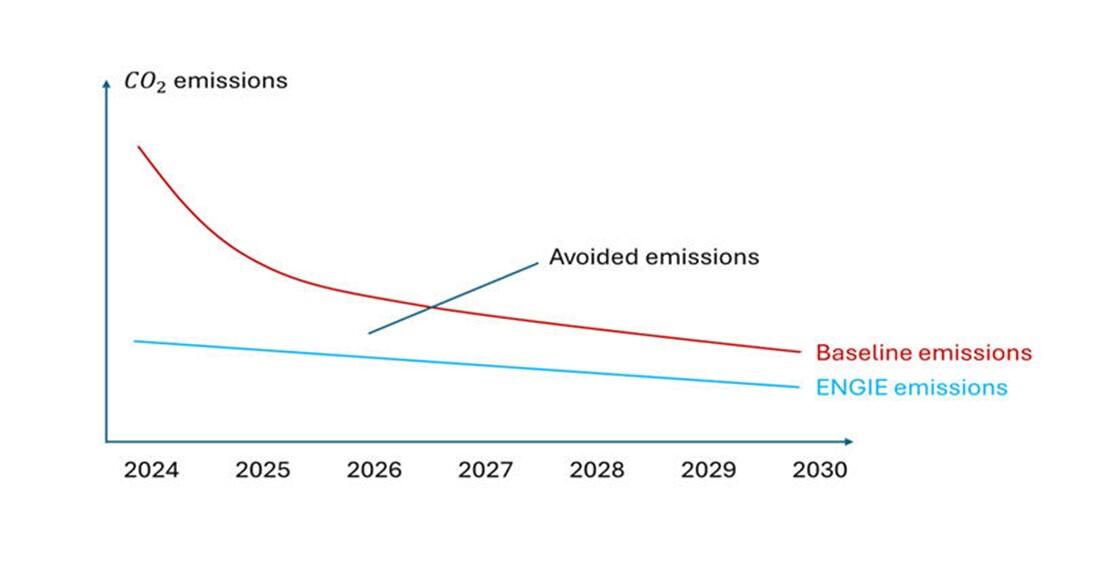
ENGIE uses the concept of avoided emissions for its customers to enhance the decarbonizing nature of its products and services. The Group has developed an internal calculation methodology and a database of emission factors which are regularly updated to bring them into line with international standards on the subject.

For a given customer need (e.g. electricity supply), the emissions avoided by an ENGIE product or service correspond to the difference between the baseline emissions and the emissions of the ENGIE product/service. All emissions are calculated using the LCA (Life Cycle Assessment) approach. The baseline corresponds to the market average of solutions that the customer would have had access to in order to satisfy its needs, in the absence of ENGIE. For each ENGIE product generating avoided emissions, particular care is therefore taken in defining the baseline, in order to build a credible and consistent scenario over time of user behaviour by country. In particular, this baseline evolves over time to reflect the decarbonization of energy systems.

4 Methodology of the calculation since 2024

Avoided emissions can therefore be calculated over the lifetime of an ENGIE asset, or on an annual basis. In the case of green bonds, avoided emissions are expressed on an annual basis. 

Emissions factors are a key element in calculating avoided emissions. ENGIE uses an internal database, maintained and developed by a dedicated R&D team. It is based on the external sources (IPPC guidelines, Ecoinvent, Enerdata for example).

For renewable electricity generation projects, the baseline corresponds to the average electricity consumption mix of the country in which the project is located, reflecting the average of technologies supplying the country's electricity. This baseline is compared with the life-cycle emissions of the ENGIE asset (solar, wind, hydro or thermal asset consuming decarbonized fuel).

For energy storage projects, the decarbonizing character comes from the fact that the assets are charged with electricity when the network is experiencing low demand (and therefore when the electricity is low-carbon) and are discharged during peaks in demand in order to relieve the network, when the electricity on the network is high in carbon. The emissions avoided come from the difference in the grid's emission factor between the peak (baseline) and off-peak periods, taking into account losses at the storage asset.

For countries where data was available, daily peak and off-peak emission factors averaged over the year were reconstructed using hourly data. For other countries, a simplified and conservative methodology was applied: the emissions of the ENGIE asset are based on the country's average electricity consumption mix, and the baseline (i.e. the network during peak periods) is modelled by a gas turbine.

For renewable gas projects, the baseline corresponds to the gas mix of the country in which the project is located, including a penetration rate for renewable gases (biomethane and green hydrogen).

To calculate the contribution of energy efficiency projects (including green buildings) to avoided emissions, ENGIE evaluates them by multiplying the energy savings brought by the project by the emissions of the energy mix of the country where the project is developed. Avoided emissions are calculated for one year of project operation, considered in the normal operating phase.

For clean mobility projects, avoided emissions are calculated by comparing the level of emissions of ENGIE projects with a baseline scenario, in this case the use for the same distance travelled of vehicles representative of the average vehicle fleet in the country or region of the project, taking into account local decarbonization trends (electrification of part of the fleet, greener fuels).


Methodology of the calculation before 2024

For renewable energy projects, the methodology for calculating avoided emissions is based on a comparison of the Life-Cycle Analysis (LCA) emission value of the energy generation technology being used by the project and that of the energy mix of the country in question. ENGIE estimates the contribution to avoided emissions resulting from green bond-funded projects by multiplying the difference between the two LCA values stated, with the plant’s capacity and the technology’s average load factor. The contribution to avoided emissions is calculated for one year of operation of the projects, considered in a full operational mode and taken at 100% regardless of the Group’s ownership rate of these projects.
Per-country reference data on average operating rates of technologies used and the average CO2 emission rates per kWh of the generation mix were drawn from data from Enerdata. The technologies’ LCA data is derived from work performed by the Intergovernmental Panel on Climate Change (IPCC). For the projects involving bioenergy and injection in the network, the quantities of biogas produced and injected into the network are considered to avoid an equivalent quantity of energy of the country mix.

For energy storage projects, The methodology for calculating the contribution to avoided emissions for storage projects is based on a comparison of the emission factors of the energy production technique implemented by the project and the reference scenario. In the case of pumped storage, a gas turbine is used as the reference. ENGIE estimates the contribution to avoided emissions of green bond-funded projects by multiplying the difference between the above emission factors by the average production of the facilities. The contribution to avoided emissions is calculated for one year of operation of the projects, considered in full operational mode and taken at 100% regardless of the Group’s ownership rate of these projects.

For energy efficiency projects, the calculation of avoided emissions is done by comparing the level of emissions of ENGIE projects with a reference scenario, the use of an individual gas heating system in the case of a district heating network, or individual air conditioning in the case of a district cooling network. The contribution to avoided emissions is calculated for one year of operation of the projects, considered in a fully operational mode and taken at 100% regardless of the Group’s ownership rate of these projects.

5. Projects and eligibility criteria

Paragraph content

The categories of projects covered by the Green Financing Framework updated 13 June 2023 are described below:

  • Renewable energy production (hydropower, geothermal energy, wind, solar, bioenergy, low-carbon hydrogen, ocean energy):

Energy transition and the development of renewable energy on a global scale are a strategic priority for ENGIE. ENGIE is targeting a 58%-66% share of installed renewable energy capacity in its electricity production portfolio, taken at 100% by 2030. With respect to renewable gases, the Group aims to reach 100% of renewable gases in its energy mix in 2050, with the intermediate objective of having a production capacity of 10 TWh per year in Europe by 2030. In France, ENGIE BiOZ initiates, develops, finances, builds and operates biomethane production units, and is one of the market leaders.

Moreover, the Group aims to have 4GW of hydrogen production via electrolysis by 2035.
 

  • Energy storage (electricity storage by pumped storage and batteries):  

Energy storage solutions play a major role in the energy transition and are an essential link in the electricity networks. By storing energy produced at times when wind and solar sources are at their most productive, and/or when demand is lowest, they respond to the need to balance intermittent supply of renewable energy, which makes up an increasing proportion of energy production. This is one of the reasons why ENGIE invests in pumped storage and battery storage. 


  • Transmission and distribution infrastructure:

In France, the Group is pursuing, through its networks business line, its efforts to develop the methanization of organic waste into renewable gases and to recover them through injection into the gas networks. This notably relates to investments to connect biomethane production units to ENGIE distribution and transmission networks.


  • Energy efficiency (including district heating and cooling networks): 

The development of highly efficient energy infrastructures to support the transition to a low-carbon economy is another one of the Group's strategic priorities.
 

  • Clean mobility (including electric charging stations):

ENGIE is strongly committed, vis-a-vis local authorities, motorway concession-holders and companies, to rolling out and connecting a network of charging stations for electric vehicles that are available and competitive, for the benefit of users. The Group has won several tenders in France and Belgium in this fast-growing market.

Additionally, the following categories were present in the Green Financing Framework of 2020:

  • green buildings;
  • carbon capture and storage;
  • sustainable management of living natural resources and land use.


They didn’t receive any allocations in 2023 and were deleted from the Green Financing Framework of 2023.
The technical eligibility criteria for the different categories of the Green Financing Framework are available on ENGIE’s website: 20230613_Engie_Green_Framework (VDEF).pdf.


Green bonds issued before June 2023 are covered by the Green Financing Framework of March 2020. The projects categories are described below:

  • renewable energy production (hydropower, geothermal energy, wind, solar, bioenergy, low-carbon hydrogen, marine energy);
  • energy storage (electricity storage by pumped storage and batteries);
  • electricity transmission and distribution infrastructure;
  • energy efficiency (including district heating and cooling networks);
  • carbon capture and storage;
  • green buildings;
  • clean transportation (including electric charging stations);
  • sustainable management of living natural resources and land use.

The technical eligibility criteria for the different categories of the 2020 Green Financing Framework are available on ENGIE’s website.

6. Allocations

Allocation of the green bonds issued between September 2023 and June 2024

Paragraph content

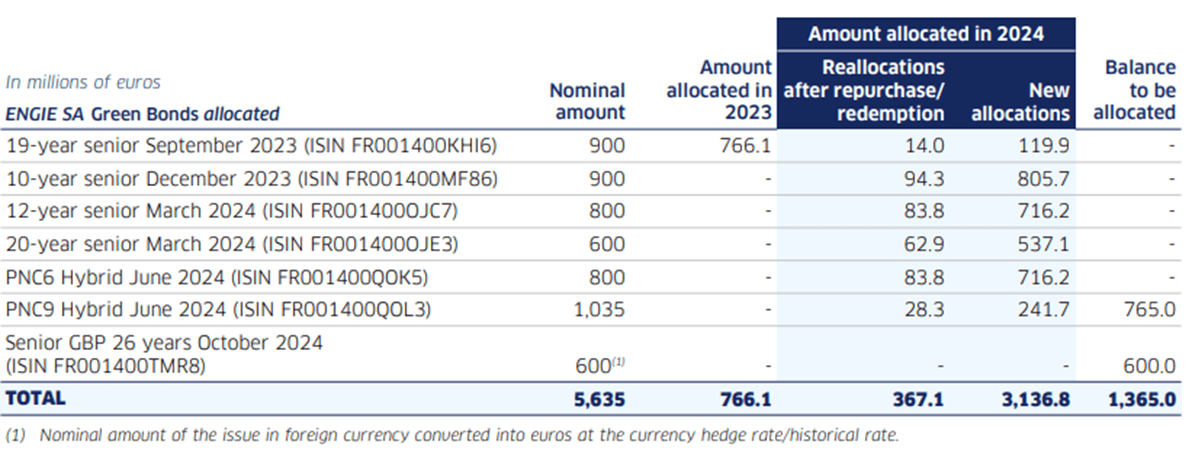
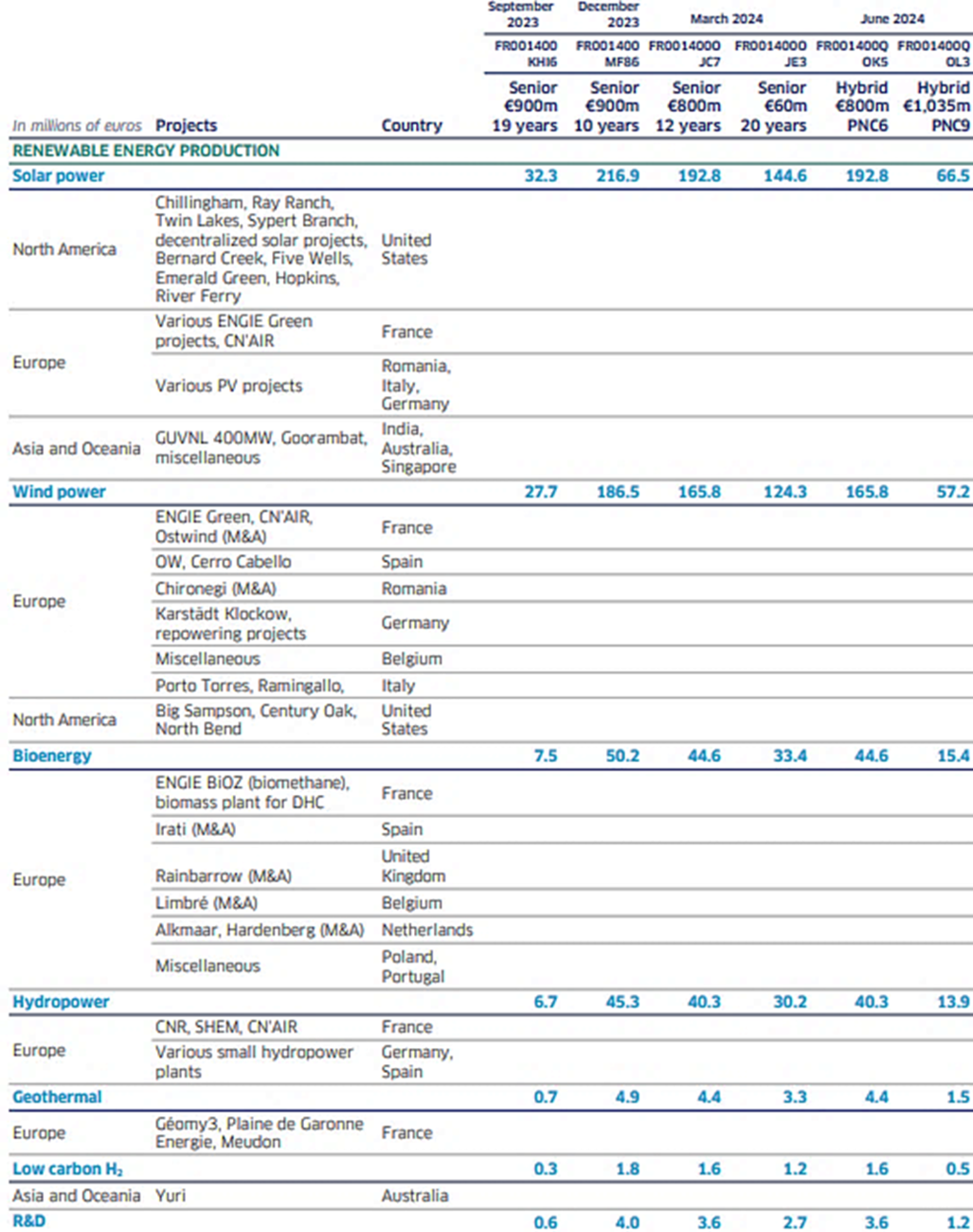
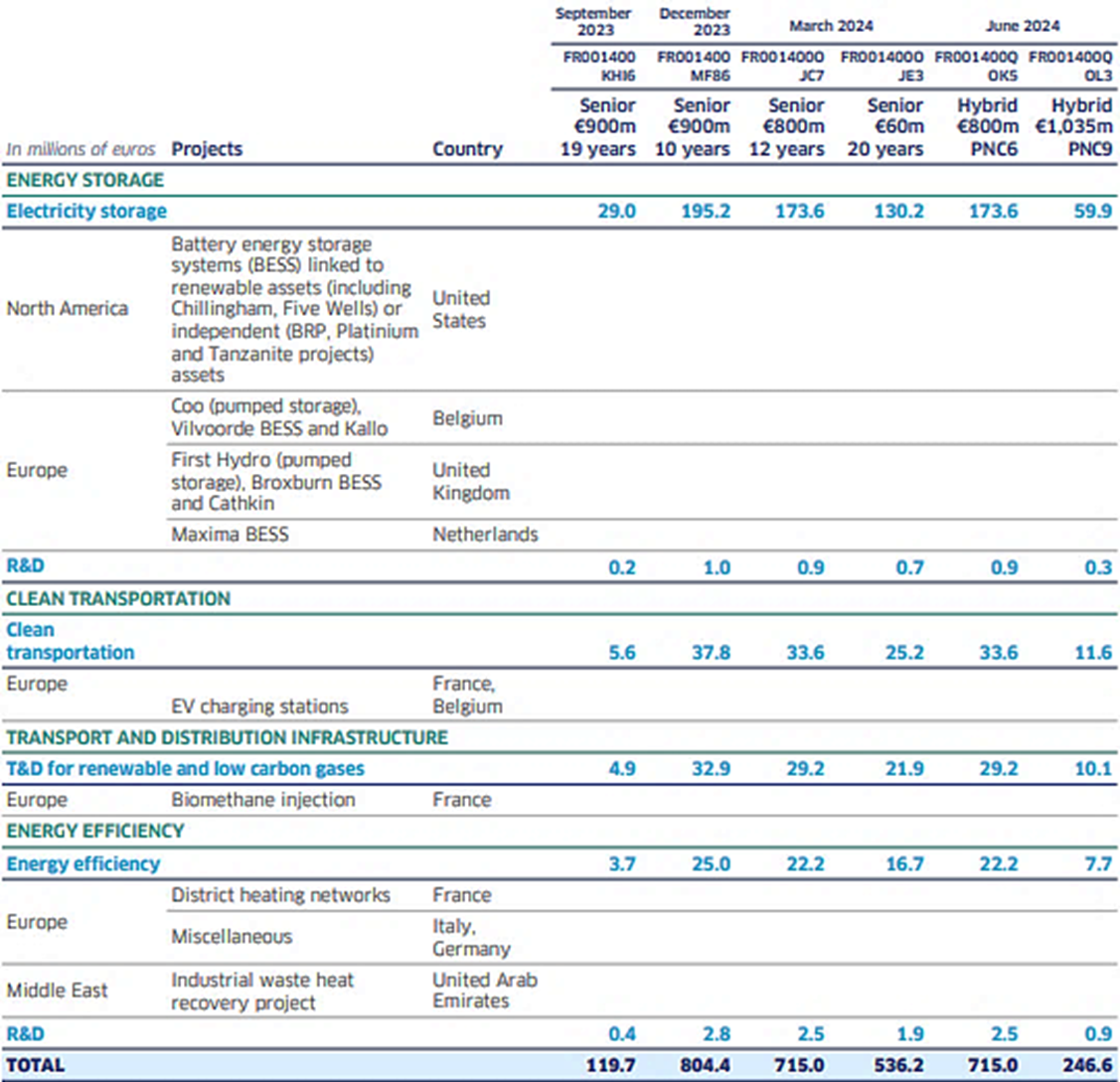
The main eligible green projects financed with the proceeds of the green bond issues carried out between September 2023 and June 2024 that meet the conditions of the above-mentioned Green Financing Framework are listed in the following table:

6.1 Allocation of the green bonds issued between September 2023 and June 2024
6.1 Allocation of the green bonds issued between September 2023 and June 2024 (2)

The projects (and the related capex) set out in the table above for a total of €3.14 billion are allocated to the green bond issued between September 2023 and June 2024; in proportions enabling the senior green bonds issued between September 2023 and March 2024 and the PNC6 hybrid bond to be fully allocated, and the PNC9 hybrid bond issued in June 2024 to be partially allocated.

The funds allocated to the eligible green projects in 2024 include €3 billion for investments made in 2024 (including €248.9 million in financial capex for the acquisition of pure-players, and €200.7 million in maintenance capex), €107.7 million for investments made in 2023, and €20.4 million for investments made in 2022.

  1. Renewable energy production: a total amount of €2 billion was allocated to eligible green projects related to renewable energy production. 
    At the end of 2024, the Group’s installed electricity production capacity, taken at 100%, represented 43% of its total installed capacity. ENGIE continued expansion of renewable assets, mainly wind and solar, and investments in offshore wind via the joint venture, Ocean Winds. 
    With respect to renewable gases, in addition to the various projects developed in France by its subsidiary ENGIE BiOZ, the Group also acquired several biomethane producers in Europe (Belgium, the Netherlands and the UK).
  2. Energy storage: a total amount of €765.4 million was allocated to eligible green projects relating to energy storage. 
    The green eligible projects in question include:
  • power battery storage projects in Belgium, the Netherlands, the UK and the United States, either independent or co-located with a renewable energy production asset;
  • the Dinorwig (1,728 MW) and Ffestiniog (360 MW) pumped storage facilities in the United Kingdom, owned and operated by First Hydro, which is 75% owned by ENGIE;
  • the Coo pumped storage plant (Belgium), where investments are being made to expand its storage facilities to increase its installed power by 79 MW;
  1. Transmission and distribution infrastructure: a total of €128.3 million was allocated to eligible green projects in this domain.
  2. Energy efficiency: a total of €108.3 million was allocated to eligible green projects relating to energy efficiency.
  3. Clean mobility: a total amount of €147.5 million was allocated to eligible green projects relating to low-carbon mobility. 


Impact reporting

The impact reporting only takes into account the new projects listed above. Reallocated projects following the buyback of previous issues are excluded.
In the full operation phase, projects are expected to contribute to avoid 2.63 million tons of CO2 eq. per year: 

  1. for renewable projects: 2.24 million tons of CO2 eq./year
  2. for storage projects: 0.03 million of CO2 eq./year
  3. for energy efficiency projects: 0.36 million tons of CO2 eq./year 


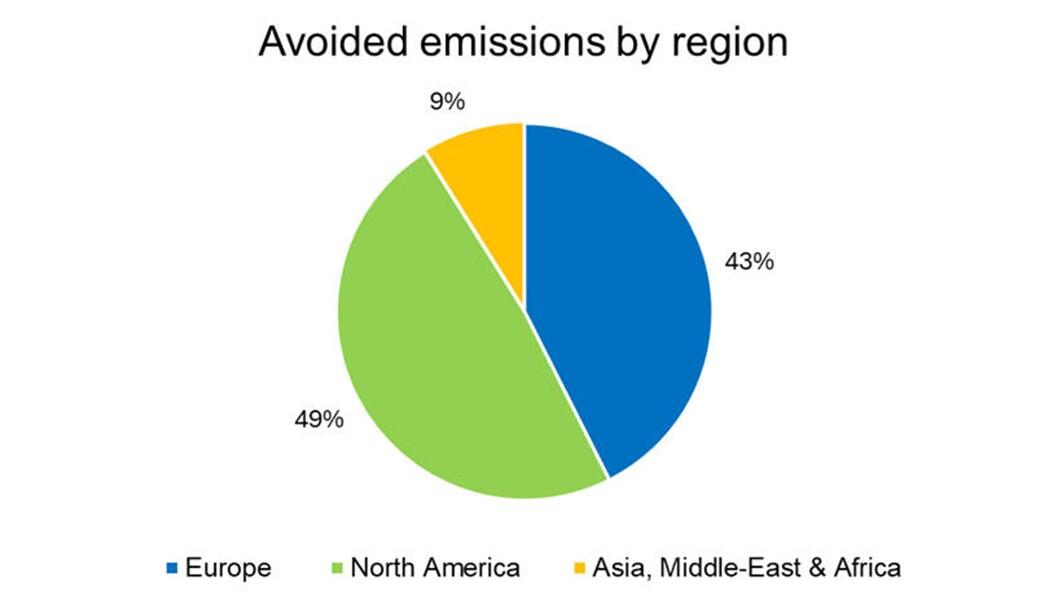
Technological and regional breakdowns of the impacts in tons of CO2 eq. per year of the projects are presented below (at 100%).

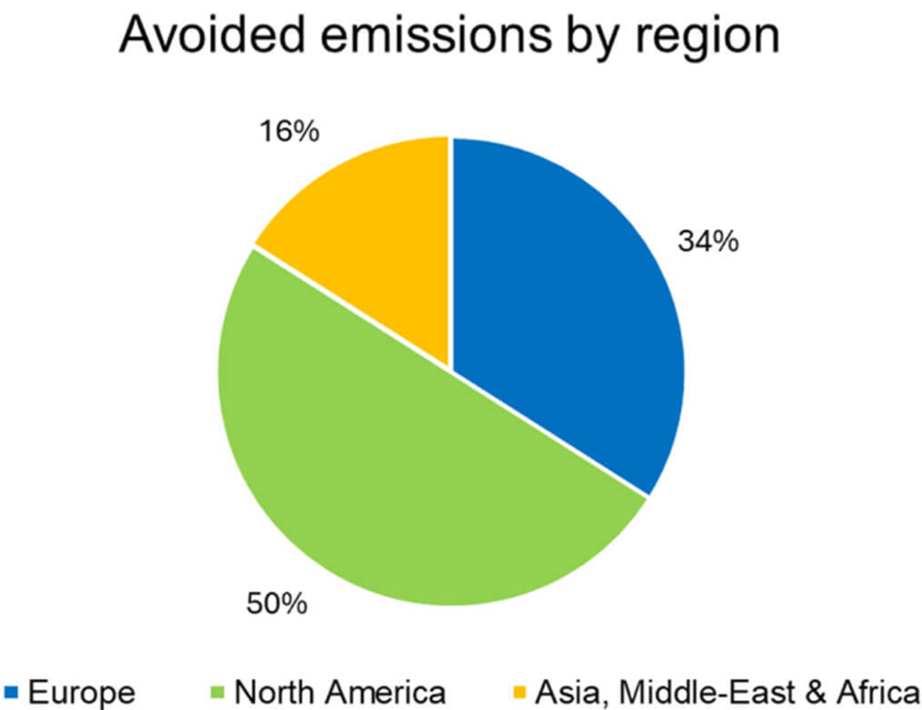
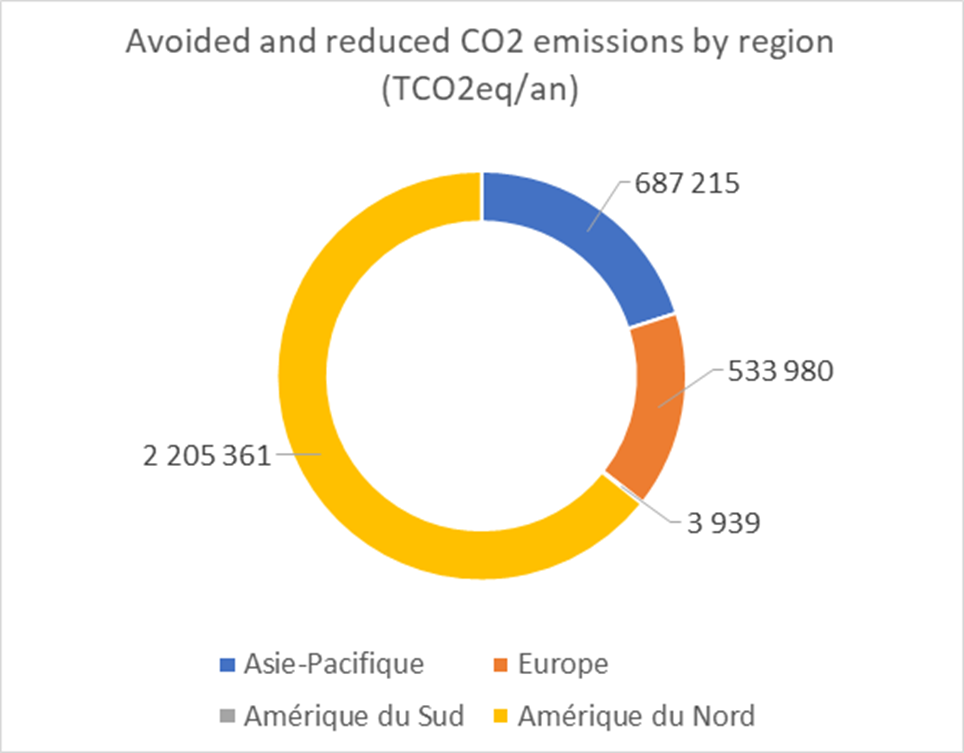
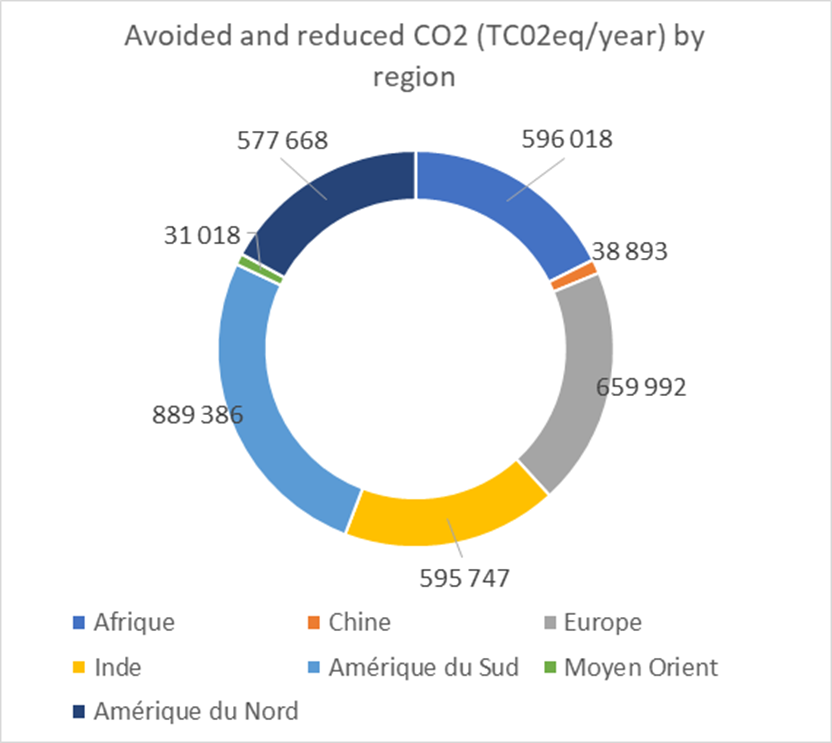
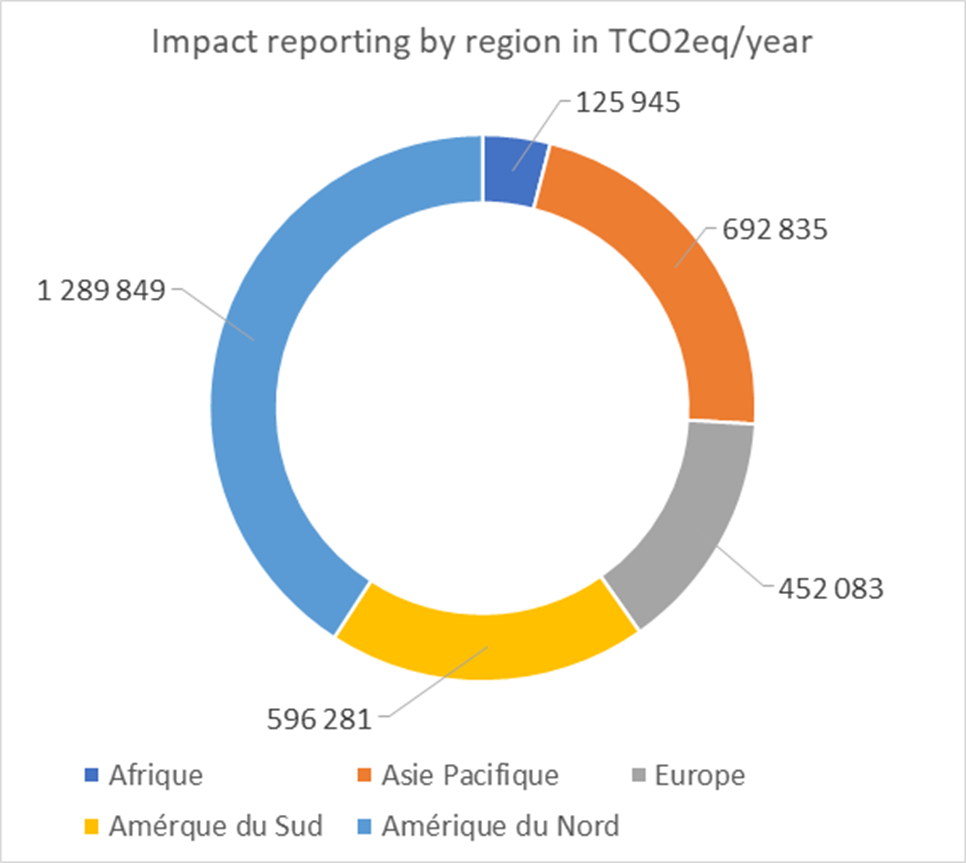
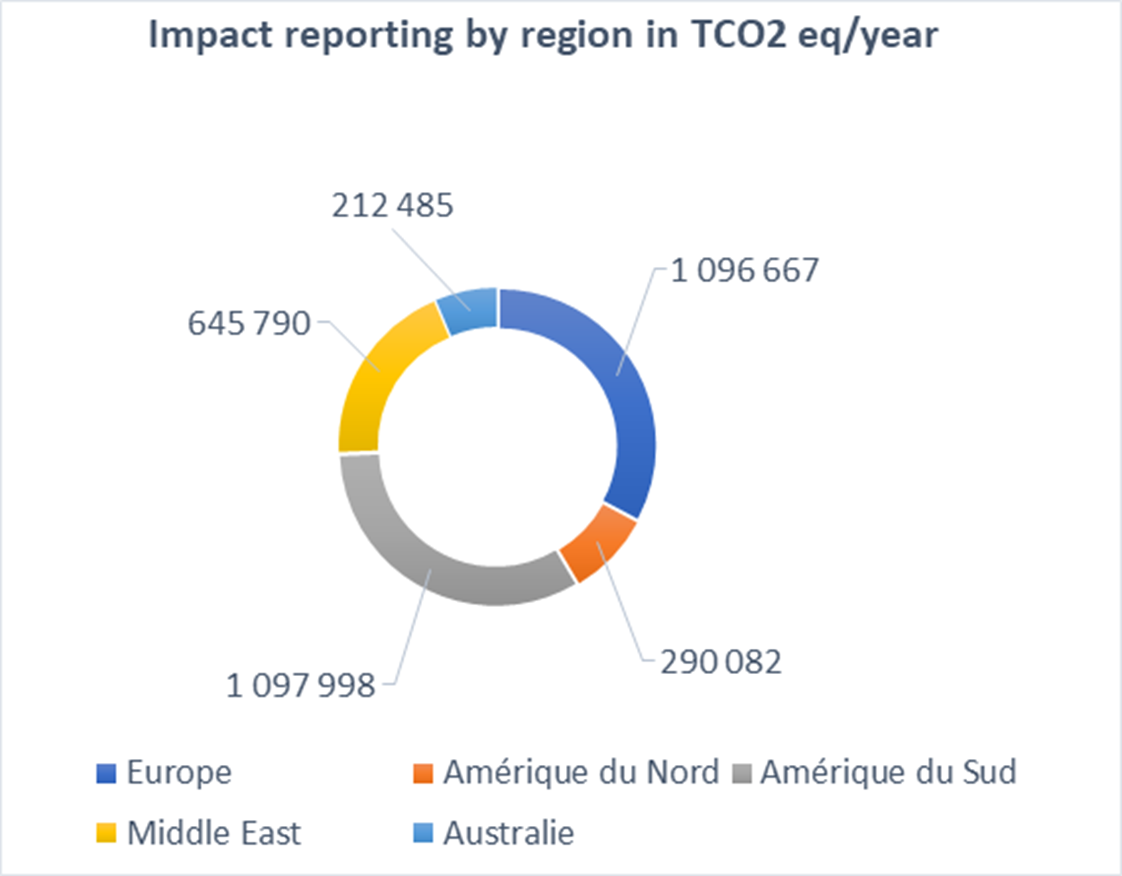
6.1 Avoided emissions by region

The contributions to avoided emissions are presented in the following table, using different weighting methods: 
a) at 100% regardless of the Group’s ownership rate and the nature of the capex
b) according to the Group's ownership rate and regardless of the nature of the capex
c) at 100% considering only the development capex
d) according to the Group's ownership rate and taking only the development capex


Avoided CO2 emissions (tCO2eq/year) by technology


(a) linked to all capex at 100%

b) linked to all capex at % of ownership

c) linked to development capex at 100%

d) linked to development capex at % of ownership

Wind power

498,315

285,893

458,790

269,419

Solar Power

1,331,110

663,121

1,329,823

661,834

Geothermal

58,603

42,776

58,603

42,776

HydroBioenergy

352,132

230,707

274,343

152,918

Hydro

-

-

-

-

Energy storage

29,752

29,515

29,752

29,515

Renewable gas

-

-

-

-

Hydrogen

2,638

2,638

2,638

2,638

Energy efficiency

354,905

304,645

354,905

304,645

Clean mobility

-

-

-

-

Total

2,627,456

1,559,295

2,508,854

1,463,745

Allocation of the green bonds issued between January and September 2023

Paragraph content

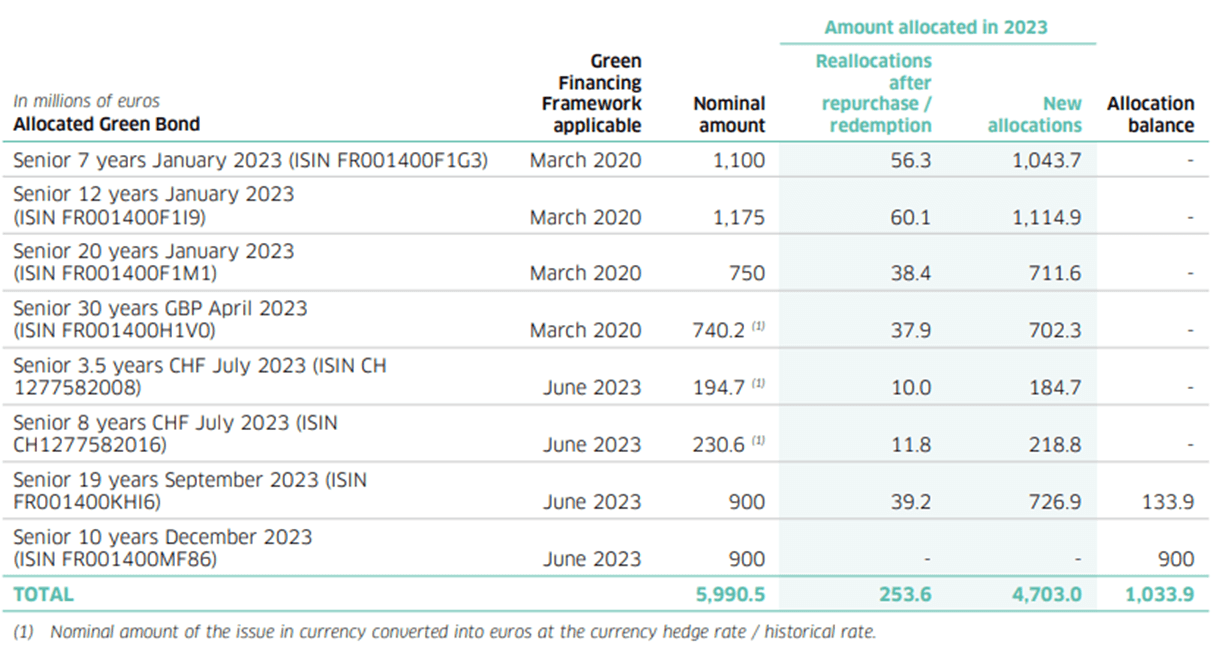
Depending on their issue dates, green bonds were allocated under either the March 2020 Green Financing Framework or the 13 June 2023 framework.
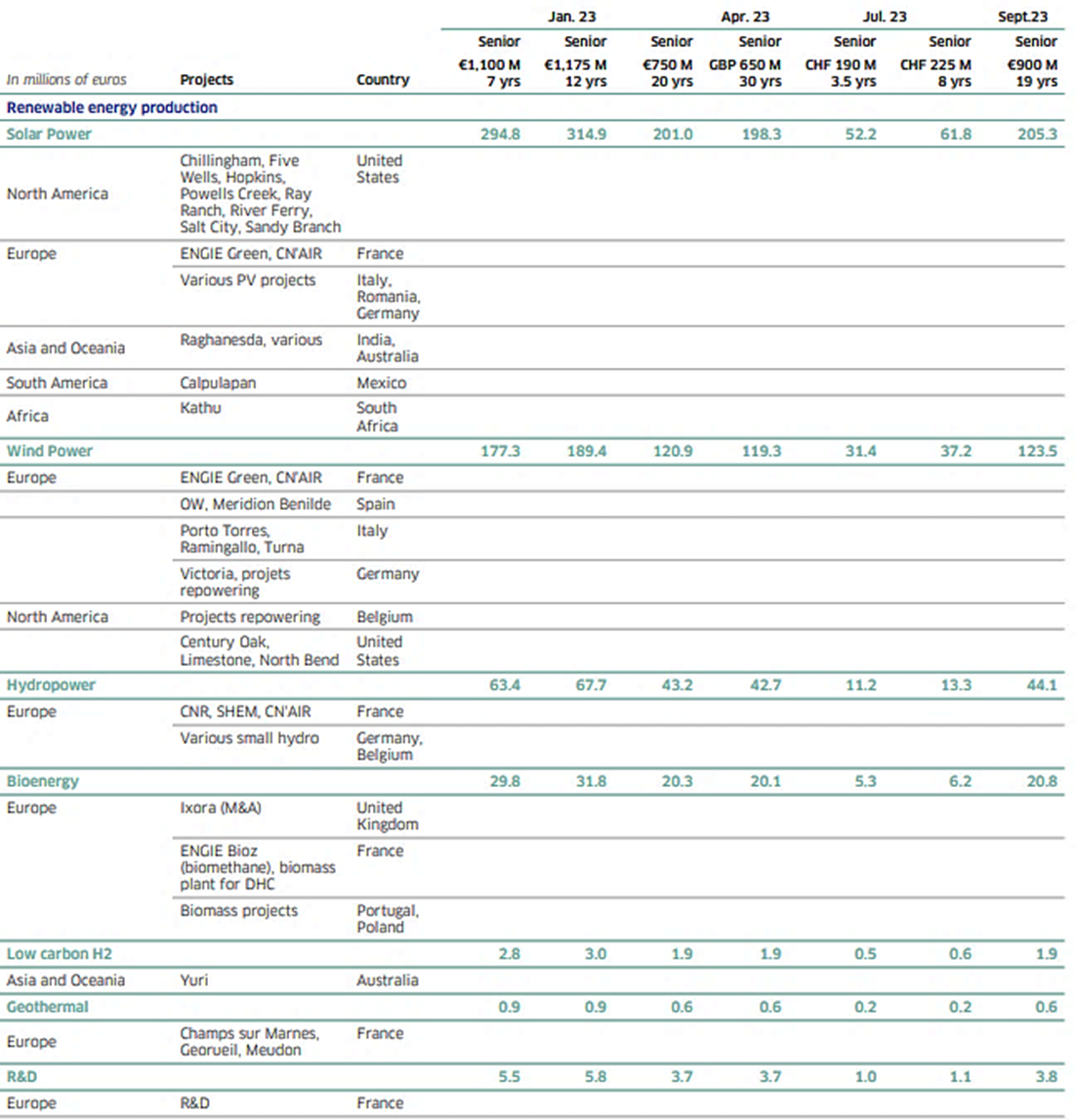
The main eligible green projects financed with the proceeds of the green bond issues carried out between January 2023 and September 2023 that meet the conditions of the above-mentioned Green Financing Framework are listed in the following table:

6.2 Allocation of the green bonds issued between January and September 2023
6.2 Allocation of the green bonds issued between January and September 2023 (2)

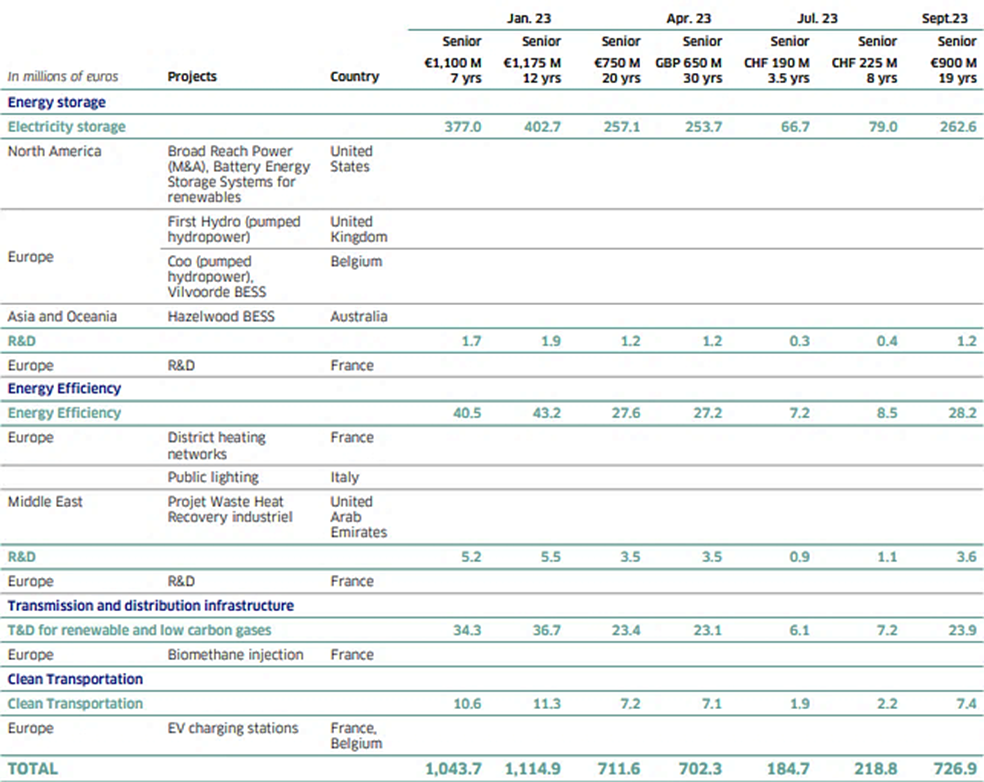
The projects (and the related capex) set out in the above table for a total of €4.70 billion are allocated globally to the green bonds issued between January and September 2023, in proportions that finalized the allocation of the green bonds issued between January and July 2023 and partially allocated the green bond issued in September 2023.

Of the funds allocated to eligible green projects during 2023, €1.2 billion related to investments made during 2022 and €3.5 billion to investments made in 2023.

  1. Renewable energy production:  total of €2.6 billion was allocated to eligible green projects related to renewable energy production. 
    At end 2023, the Group’s installed electricity production capacity, taken at 100%, represented 41% of its total installed capacity.  ENGIE continued expansion of renewable assets, mainly wind and solar, and investments in offshore wind via the joint venture, Ocean Winds.  With respect to renewable gases, ENGIE acquired Ixora Energy Ltd, a leader in biomethane production in the UK, with a production capacity of 160 GWh per year.   
  2. Energy storage: a total amount of €1.7 billion was allocated to eligible green projects relating to energy storage. 
    The green eligible projects in question include:
  • the acquisition of Broad Reach Power, a Houston-based company specialized in battery storage activities. The transaction involved 350 MW of operational assets, 880 MW of assets under construction with commissioning expected before the end of 2024, and 1.7 GW of projects at an advanced stage of development;
  • the Dinorwig (1,728 MW) and Ffestiniog (360 MW) pumped storage facilities in the United Kingdom, owned and operated by First Hydro, which is 75% owned by ENGIE;
  • the Coo pumped storage plant (Belgium) where investments are being made to expand its storage facilities to increase its installed power by 79 MW;
  • the power battery storage project in Hazelwood, Australia.
  1. Transmission and distribution infrastructure: a total of €155 million was allocated to eligible green projects in this domain.
  2. Energy efficiency:  a total of €206 million was allocated to eligible green projects relating to energy efficiency.
  3. Clean mobility: a total amount of 48 million was allocated to eligible green projects relating to low-carbon mobility.


Impact reporting 

The impact reporting takes into account only the new projects listed above. Reallocated projects following the buyback of previous issues are therefore excluded.
In the full operation phase, the projects are expected to contribute to avoid 3.7 million tons of CO2 eq. per year: 

  • for renewable projects: 2.36 million tons of CO2 eq./year
  • for storage projects: 0.46 million tons of CO2 eq./year
  • for renewable gases projects in infrastructure: 0.49 million tons of CO2 eq./year
  • for energy efficiency projects: 0.34 million tons of CO2 eq./year
  • for clean mobility projects: 0.02 million tons of CO2 eq./year


Breakdowns by technology and by region of the impacts in tons of CO2 eq. per year of the projects are presented below (at 100%).

6.2 Avoided emissions by region

Contributions to avoided emissions are presented in the following table, using different weighting methods: 
a) at 100% regardless of the Group’s ownership rate and the nature of the capex
b) according to the Group's ownership rate and regardless of the nature of the capex
c) at 100% considering only development capex 
d) according to the Group's ownership rate and taking only the development capex


Avoided CO2 emissions (tCO2eq/year) by technology


(a) linked to all capex at 100%

b) linked to all capex at % of ownership

c) linked to development capex at 100%

d) linked to development capex at % of ownership

Wind power

844,490

371,398

844,490

371,398

Solar Power

1,271,630

597,825

1,271,630

597,825

Geothermal

29,703

7,426

29,703

7,426

Bioenergy

200,603

143,603

186,632

129,632

Hydro

10,376

10,376

-

-

Energy storage

466,116

462,305

224,363

220,552

Renewable gas

487,149

487,149

487,149

487,149

Hydrogen

5,191

5,191

5,191

5,191

Energy efficiency

340,713

290,453

340,713

290,453

Clean mobility 

19,516

5,358

19,516

5,358

Total

3,675,487

2,381,084

3,409,387

2,114,984

Allocation of the October 2021 and September 2022 green bonds

Paragraph content

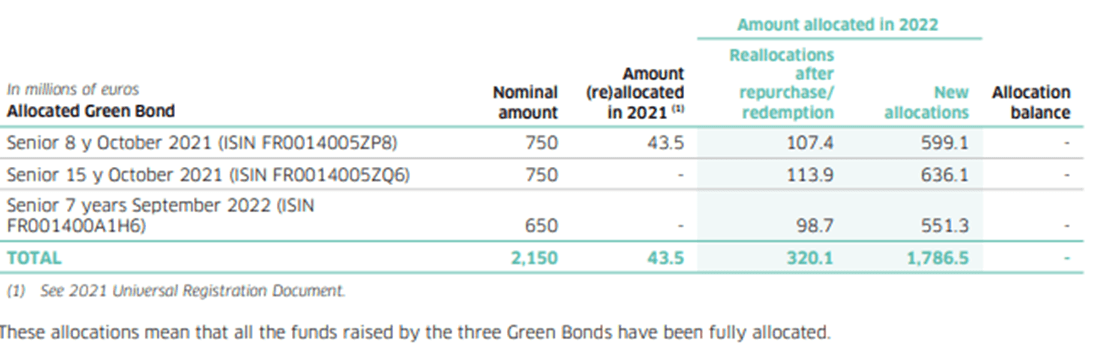
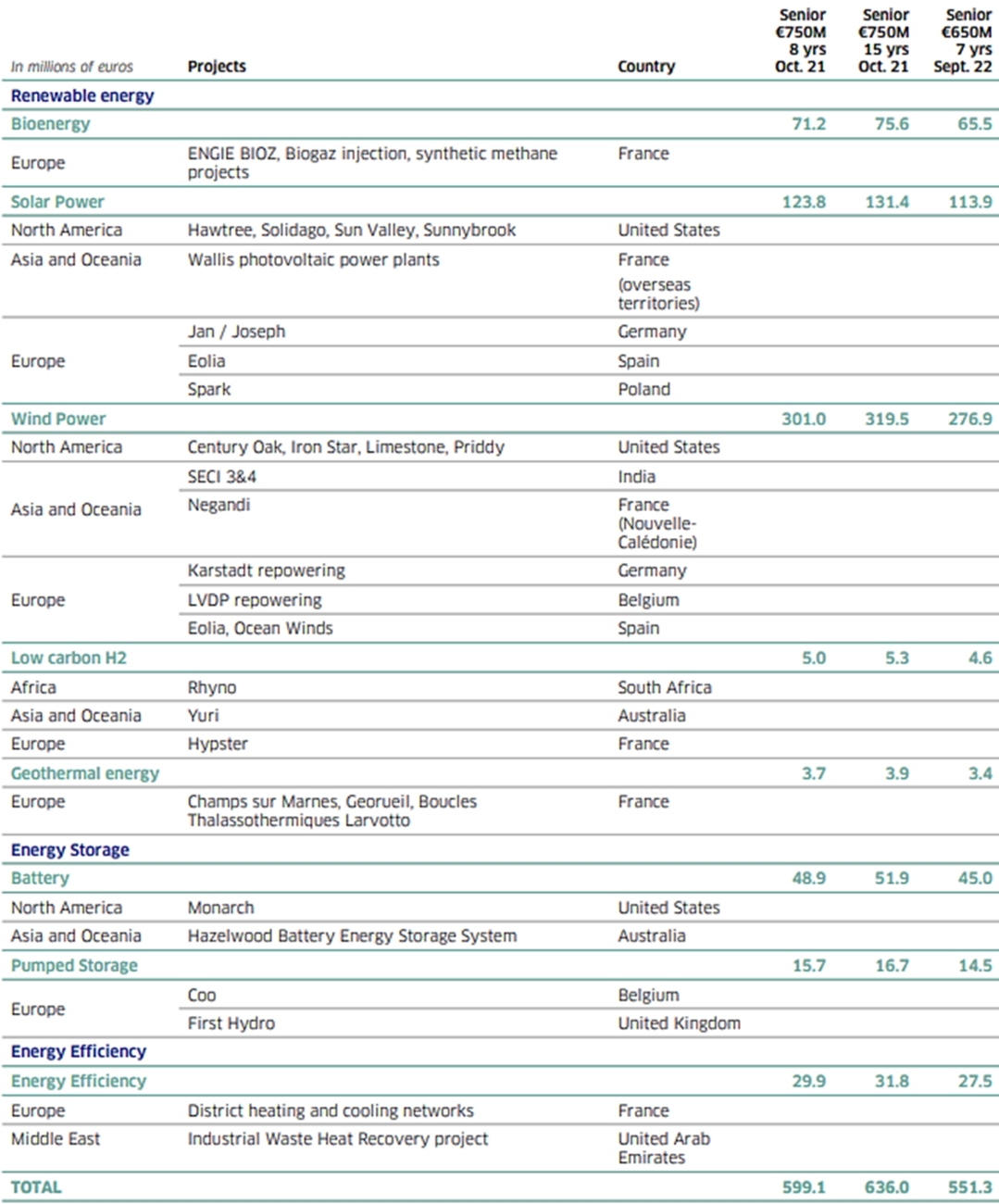
The main eligible green projects financed by the green bond issues of October 2021 (ISIN: FR0014005ZP8 and FR0014005ZQ6) and of September 2022 (ISIN: FR001400A1H6) that meet the aforementioned conditions of the Green Financing Framework are listed in the table below:

6.3 Allocation of the October 2021 and September 2022 green bonds

The funds allocated to eligible green projects throughout 2022 relate solely to investments made in the same year. With respect to the October 2021 (8-year and 15-year tranches) bond and September 2022 (7-year tranche) bond, allocations were as follows:

  1. Renewable energy production: a total of €1.50 billion was allocated to eligible green projects related to renewable energy production.
    The Group’s installed electricity production capacity, taken at 100% for its renewables production businesses accounted for 38% of its total installed capacity. and investments in offshore wind via the joint venture, Ocean Winds. In May 2022, the Group and its partner Crédit Agricole Assurances finalized the acquisition of Eolia, a major renewables player in Spain. In France, the Group, through ENGIE BiOZ and its infrastructure business line, pursued efforts to develop the sector of waste methanization into renewable gases and their recovery through injection into the natural gas transmission and distribution network.
  2. Energy storage: a total amount of €192.6 million was allocated to eligible green projects relating to energy storage. 
    The green eligible projects in question include:
  • the Dinorwig (1,728 MW) and Ffestiniog (360 MW) pumped storage facilities in the United Kingdom, owned and operated by First Hydro, which is 75% owned by ENGIE;
  • the Coo pumped storage plant (Belgium) where investments are being made to expand storage facilities and increase installed power by 79 MW;
  • the power battery storage project in Hazelwood, Australia;
  • the acquisition of a pipeline of solar energy and paired and stand-alone battery storage development projects from Belltown Power U.S. in the United States (Monarch transaction). The transaction covers 33 projects, including 0.7 GW of paired storage and 2.6 GW of stand-alone battery storage.
  1. Energy efficiency: a total of €89.3 million was allocated to eligible green projects in this domain.
     

Impact reporting

The impact reporting takes into account only the new projects allocated in 2022. Reallocated projects following the buyback of previous issues are excluded.
In the full operation phase, the projects are expected to contribute to avoiding 3.8 million tons of CO2 eq. per year:

  • for renewable projects: 3.35 million tons of CO2 eq./year;
  • for energy efficiency projects: 0.45 million tons of CO2 eq./year;
  • for storage projects: 0.016 million tons of CO2 eq./year.


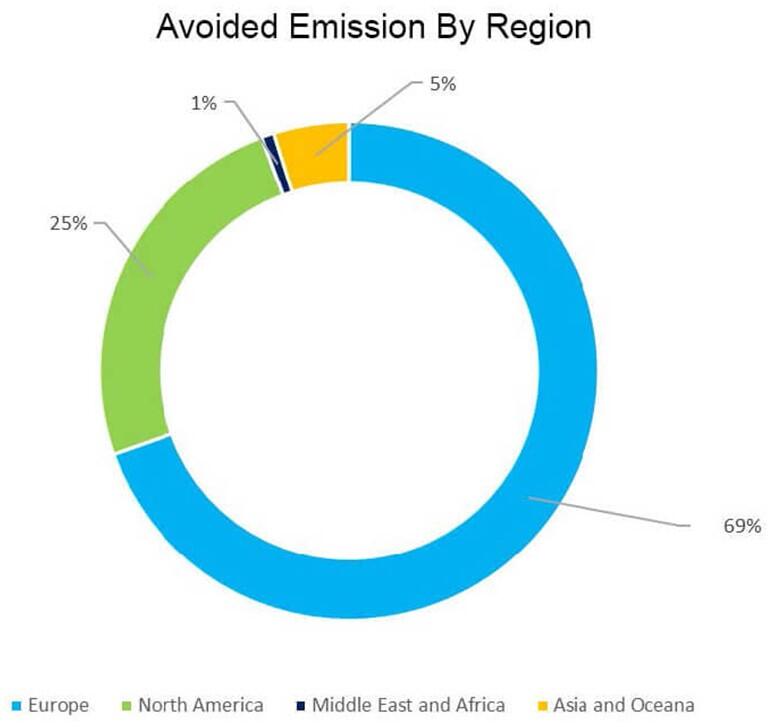
Breakdowns by technology and region, of the impacts in tons of CO2 eq. per year, for the projects are presented below (at 100%).

6.3 Avoided emissions by region

The contributions to avoided emissions are presented in the following table using different weighting methods: 
a) at 100% regardless of the Group’s ownership rate and the nature of the capex
b) according to the Group's ownership rate and regardless of the nature of the capex
c) at 100% considering only development capex 
d) according to the Group's ownership rate and taking only the development capex


Avoided CO2 emissions (TCO2eq/year) by technology


(a) linked to development and financial CAPEX taken at 100%

b)    linked to development and financial CAPEX taken at % of ownership


c)    linked to development CAPEX taken at 100%


d)    linked to development CAPEX taken at
% of ownership

Wind power2,434,1471,487,517700,393363,956
Solar Power389,914264,164360,319234,569
Energy
efficiency
454,390376,140454,390376,140
Bioenergy505,552399,468500,844396,512
Hydrogen8,6788,6788,6788,678
Energy storage15,75015,75015,75015,750
Geothermal8,6008,6008,6008,600
Grand Total3,817,0312,560,3172,048,9741,404,205

Allocation of the March, November 2020 and July 2021 green bonds

Paragraph content

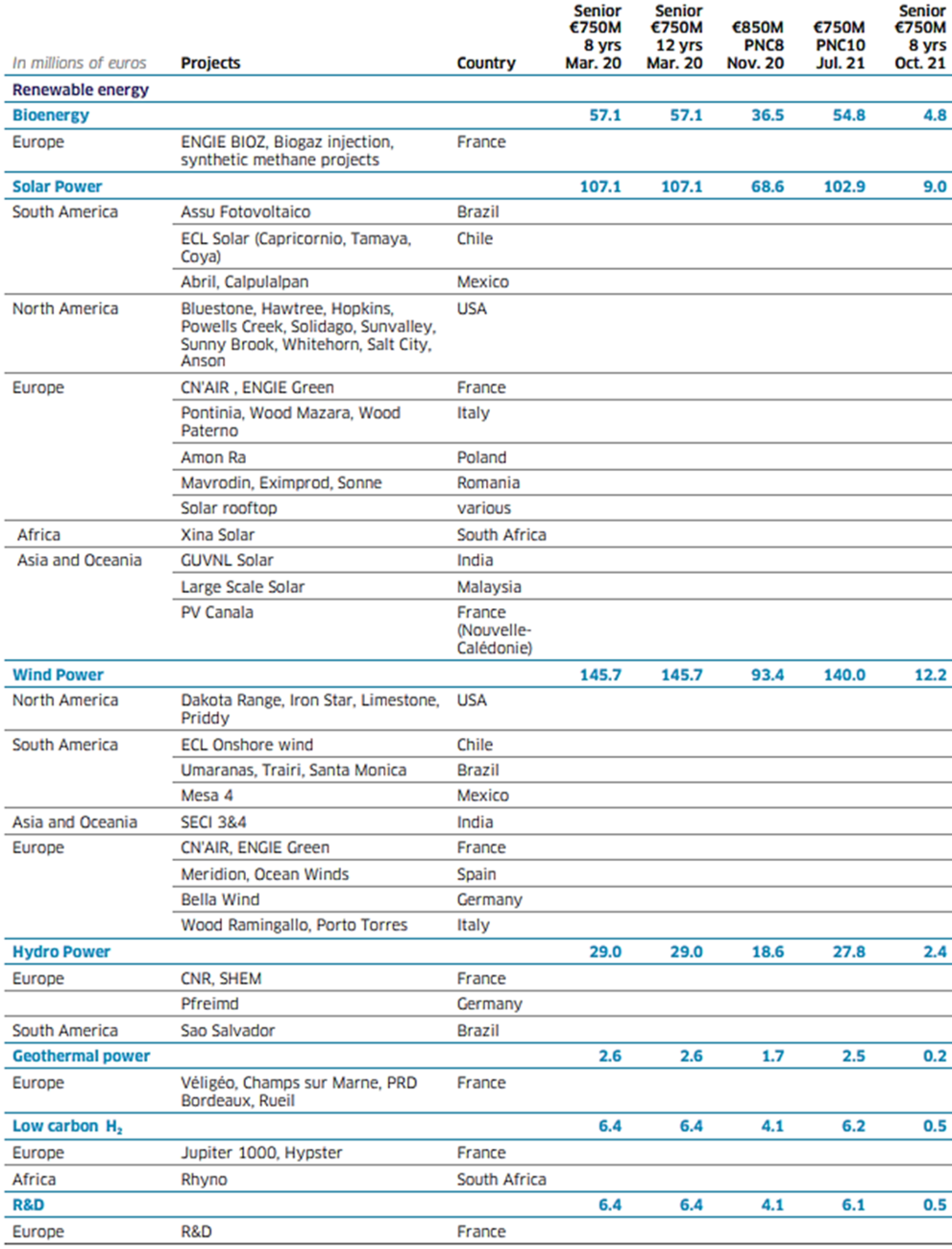
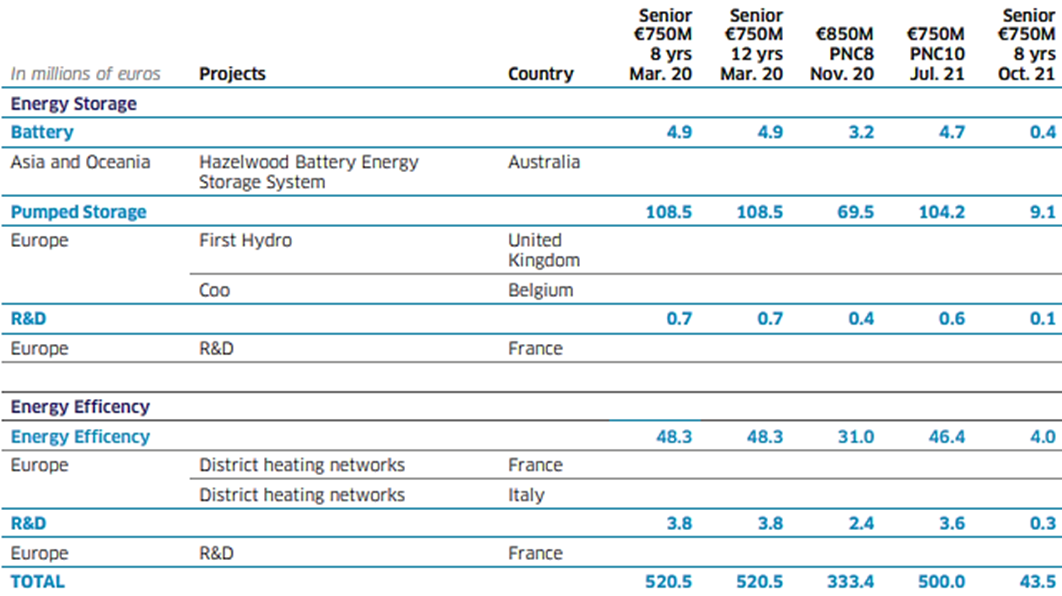
The main eligible projects that were financed in 2021 with the proceeds of the March, November 2020 and July 2021 green bond issues that comply with the ENGIE Green Financing Framework are presented in the following table:

6.4 Allocation of the March, November 2020 and July 2021 green bonds
6.4 Allocation of the March, November 2020 and July 2021 green bonds (2)

ENGIE continued expansion of renewable assets, mainly wind, solar and geothermal, by developing new projects, particularly in North America, South America and Europe. In France, the Group, through ENGIE BiOZ, and its infrastructure business line, pursued its efforts to develop the sector of waste methanization into renewable gases and its recovery through injection into the natural gas transmission and distribution network.

ENGIE continued the development of urban heating and cooling networks in Europe, particularly in France. In the United States, ENGIE entered a partnership with the University of Georgetown for the management of energy infrastructure and campus techniques with ambitious targets in terms of sustainable development and energy savings. For the duration of the agreement, ENGIE will be responsible for improving, operating, and maintaining electrical, heating, cooling, and water distribution systems, with a target of reducing energy intensity by 35% by 2030.


Impact reporting

The impact reporting only takes into account the new projects presented in the table above. Reallocated projects following the buyback of previous issues are excluded.
In the full operation phase, the projects are expected to contribute to avoid emissions of at least 4.54 million tons of CO2 eq. per year: 

  • for renewable projects, a minimum of 4.12 million tons of CO2 eq./year,
  • for energy efficiency projects, 0.38 million tons of CO2 eq./year,
  • for storage projects, 0.04 million tons of CO2 eq./year.


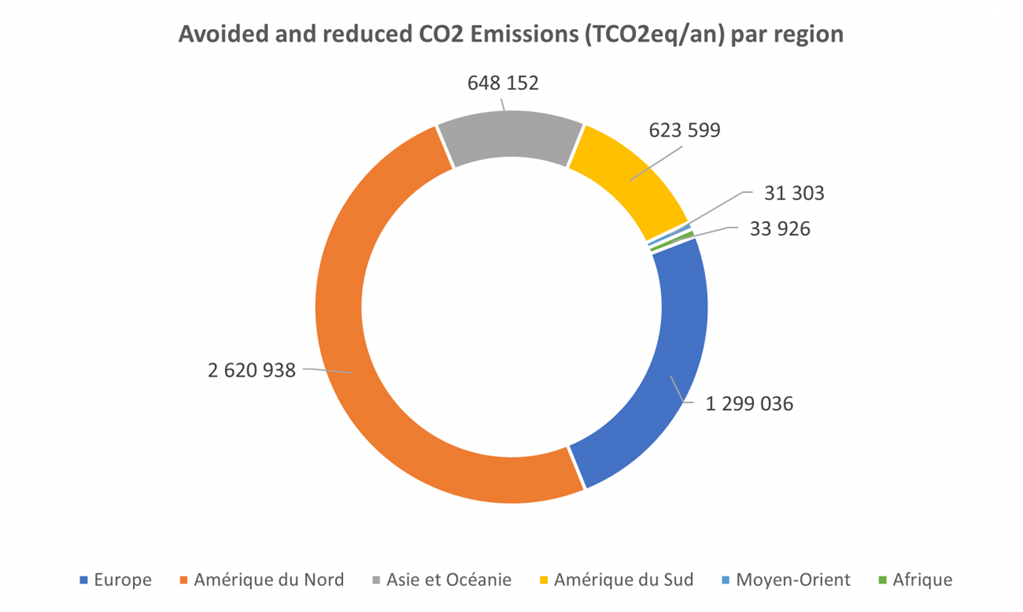
Breakdowns by technology and region of the impacts, in tons of CO2 eq. per year, for the projects financed by the green bonds of March, November 2020 and July 2021 are presented below (at 100%)

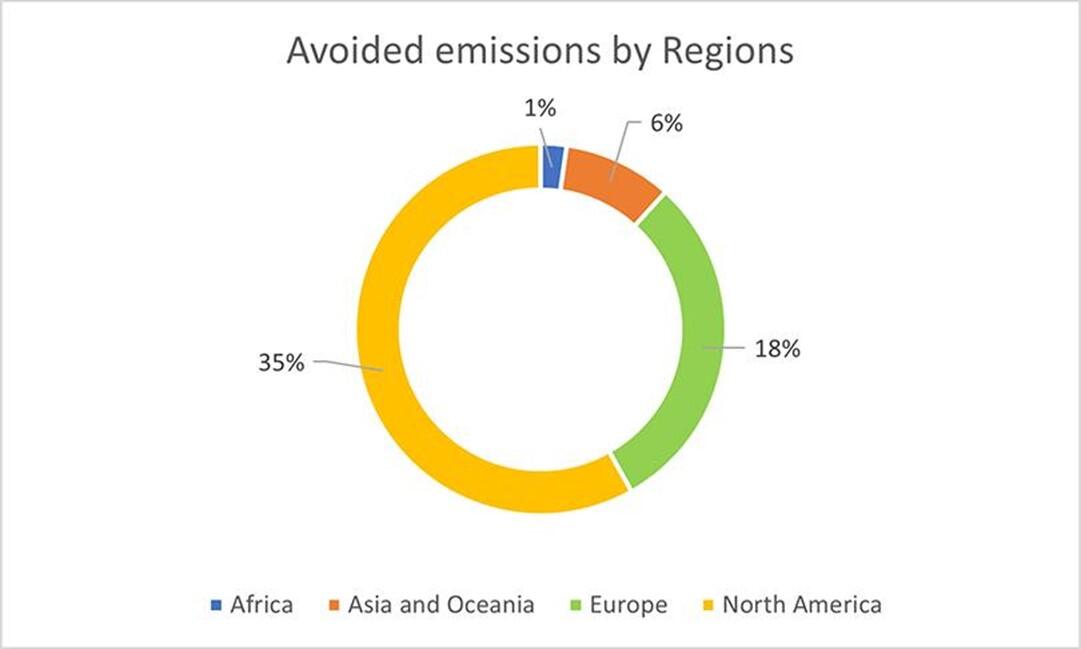
6.4 Avoided emissions by region

The contributions to reduced or avoided emissions are presented in the following table using different weighting methods: 
a) at 100% regardless of the Group’s ownership rate and the nature of the capex
b) according to the Group's ownership rate and regardless of the nature of the capex
c) at 100% considering only development capex 
d) according to the Group's ownership rate and taking only the development capex


Avoided and reduced CO2 emissions (TCO2eq/year) by technology
 (a) linked  to development and financial CAPEX taken at 100%b) linked  to development and financial CAPEX taken at % of ownershipgc) linked  to development CAPEX taken at 100%d) linked  to development CAPEX taken at % of ownershipg
Wind power2.287.6161.384.2462.287.6161.384.246
Solar Power1.471.779994.2811.404.808962.933
Energy efficiency377.626346.899328.055328.042
Bioenergy358.800310.125358.800310.125
Hydrogen2.2872.2872.2872.287
Pumped Storage12.12412.12412.12412.124
Battery30.94721.66330.94721.663
Hydro power353177353177
Grand Total4.541.5323.071.8024.424.9903.021.596

Allocation of green bonds of June and October 2019

Paragraph content

The main eligible projects that were financed in 2020 with the proceeds of the June and October 2019 green bond issues are presented in the following table. 


In millions of eurosProjectsCountrySenior €750 m
8 Y Jun 19

Senior  €750 m 20 Y Jun 19

Senior  €900 m 11 Y Oct 19
Type of Project: Renewable Energy
Technology: Hydropower 201205246
EuropeMonet*Portugal
CN'AIR Hydro*France
Technology: Solar 201204245
South AmericaCapricornio, TamayaChili
Abril, Calpulalpan, Sol de Insurgentes, Villa AhumadaMexico
SD ParacatuBrazil
North AmericaAnson, Bluestone, Long Draw, Whitehorn (Gretna), Hawtree*United States
EuropeCN'AIR Solar, Engie Green, Développement PV E&C*France
Sonne PV*Romania
AfricaFenixSeveral countries (1)
Scaling SolarSénégal
Asia and OceaniaGUVNLIndia
RetopChina
Middle EastNadecSaudi Arabia
Technology: Wind 194196237
North AmericaDakota Range, East Forks, Iron Star*, Jumbo Hill, King Plains, Las Lomas,  Prairie Hill, Solomon Forks, Triple H, Priddy*United States
South AmericaCalamaChili
Tres Mesas 4Mexico
EuropeOW*, CN'AIR Wind, Engie Green On-shore, Renvico*, ABOWind*France
Renvico*, Wood*Italy
Technology: Bioenergy 222327
EuropeGRDF (Injection de biogaz dans le réseau), Engie BiOZ, DSP Pau*France
Technology: Geothermal 444
EuropeChamps sur Marne*, Vélidis*France
Asia and OceaniaSupreme Muara LabohIndonesia
Technology: R&D 9911
Type of Project: Energy Efficiency
Technology: Energy efficiency 777894
EuropeGazpar, Réseaux de Chaleur Urbains, Storengy (projets Hydrogen et synthetic methane)*France
GAMOR*Germany
ENGIE New VenturesSeveral countries
Asia and OceaniaPunggol DCS*Singapore
Technology: Pumped Storage 141518
EuropeFirst Hydro (Ffestiniog 1&2)*United Kingdom
Technology: R&D 555
Type of project: Clean Transportation
Technology: Clean Transportation 567
EuropeGNVERT*France
Technology: EV 333
Asia and OceaniaEVChong*China
Technology: Hydrogen 222
AfricaRhyno*South Africa
EuropeDMSE*, Zero Emission Valley*France
SUB-TOTAL 737750900
 
ALLOCATED IN 2019     
Type of project: Clean Transportation
Technology: EV 13--
EuropeChargePointUnited Kingdom
TOTAL 750750900
* New eligible projects
(1) Uganda, Zambia, Benin, Nigeria, Mosambique


Main projects concern the development of solar and wind farms in Europe, South and North America (Website of wind and solar projects in the US). The Group also acquired 2 GW of renewable capacity in operation through the acquisition of hydraulic dams owned by EDP, as well as  Renvico wind parks in Portugal. Energy efficiency allocations relate to projects developing heat and smart metering networks in France, as well as extended pumped storage stations in England.

Impact reporting 
In the full operation phase, the projects are expected to contribute to avoid emissions of at least 5.26 million tons of CO2 eq. per year: 

  • for renewable projects, a minimum of 5.05 million tons of CO2 eq. per year;
  • for energy efficiency projects, 0.21 million tons of CO2 eq. per year;
  • for clean transportation projects, approximately 0.5 thousand tons of CO2 eq. per year.


Breakdowns by technology and region, of the impacts in tons of CO2 eq. per year of the projects financed by the green bonds of June and October 2019 are presented below (at 100%).

6.5 Avoided emissions by region

Contributions to reduced or avoided emissions are presented in the following table using different weighting methods: 
a) at 100% regardless of the Group’s ownership rate and the nature of the capex ;
b) according to the Group's ownership rate and regardless of the nature of the capex ;
c) at 100% considering only development capex ;
d) according to the Group's ownership rate and taking only the development capex.


Avoided and reduced CO2 emissions (TCO2eq/year) by technology
 (a) linked  to development and financial CAPEX taken at 100%b) linked  to development and financial CAPEX taken at % of ownershipgc) linked  to development CAPEX taken at 100%d) linked  to development CAPEX taken at % of ownershipg
Wind2,682,561 1,407,727 2,591,355 1,388,979
Solar962,585 711,402  959,078 707,895
Hydro906,769 362,72113065
Geothermal430,848 154,243 5,302 5,302
Energy efficiency187,586 159,617187,586159,617
Bio energy67,120 65,43967,120 65,439
Pump storage19,067 14,30019,067 14,300
Clean mobility298298298298
Electric vehicles11936--
Hydrogen----
Total5,256,954 2,875,783 3,829,935 2,341,895

Allocation of the January 2019 green bond

Paragraph content

The main eligible projects that were financed in 2019 with the proceeds of the January 2019 green bond issue are presented in the following table. 


Project typeTechnologyRegionProjects nameCountryCAPEX (in million euros)
RenewableWindEuropeProjects of CN’AIR, ENGIE Green, LANGA et Saméole France451
WindfloatPortugal
North AmericaKing Plains, Las Lomas, Live Oak(1), Dakota Range III, Prairie Hill, Triple H, Solomon Forks(1) United States
Asia and OceanieWillogeleche(1)Australia
SolarEuropeProjects of CN’AIR, ENGIE Green, LANGAFrance90
North AmericaAnson, Bluestone, Gretna, Long DrawUnited States
Asia and OceanieLifou, Kota-bore, Lavaghu, KoumacNouvelle Calédonie
Biomass-biogasEuropeVolV biomassFrance93
DSP Macon(1), DSP Bordeaux 
Biogaz injector 
GeothermalAsia and OceanieMuara Laboh(1)Indonesia13
R&DEurope France46
Global capex in million euros for renewable energy projects693
Energy efficiencyDistrict heating systemEuropeProjects of ENGIE RéseauxFrance4
District cooling systemEuropeProjects of Climespace(1)France6
Energy efficiencyEuropeCertiNergy & SolutionsFrance81
R&DEurope France47
Global capex in millions of euros for energy efficiency projects138
Clean MobilityClean MobilityEuropeChargePointUnited Kingdom165
PowerlinesGermany
GNVvertFrance
EV Box(1)The Netherlands
South AmericaTransantiago(1), Los Andes Rent a CarChili
R&DEurope France4
Global capex in millions of euros for clean mobility projects169
TotalGlobal capex in million euros1000
(1)     Eligible projects having received an allocation in previous Green Bonds


The main new projects concern the development of solar and wind farms in France and North America. The Group has also acquired Vol-V Biomasse thus becoming the leading biomethane producer in France, with the aim of accelerating the development of this sector in France. The main project allocated in terms of energy efficiency is the acquisition of CertiNergy, which reinforces the Group's position on energy saving certificates to accelerate the energy transition of companies and communities. In terms of mobility, the green bond of January 2019 has enabled ENGIE to finance various projects presented in the following link (Clean Mobility) and in particular the acquisition of Powerlines, which enables the Group to become a major player in the electrification of rail networks in Europe.


Impact reporting 

In the full operation phase, the projects are expected to contribute to avoid emissions of at least 3.43 million tons of CO2eq. per year: 

  • for renewable projects, a minimum of 3.02 million tons of CO2 eq./year;
  • for mobility projects, 0.04 million tons of CO2 eq./year;
  • for energy efficiency projects, a minimum of 0.37 million tons of CO2e q./year.


Breakdowns by technology and region of the impacts in tons of CO2 eq. per year of the projects financed by the green bond of January 2019 are presented below (at 100%).

6.6 Avoided emissions by region

Contributions to reduced or avoided emissions are presented in the following table using different weighting methods: 
a) at 100% regardless of the Group’s ownership rate and the nature of the capex
b) according to the Group's ownership rate and regardless of the nature of the capex
c) at 100% considering only development capex
d) according to the Group's ownership rate and taking only the development capex


Contribution to avoided and reduced CO2 Emissions (T C02 eq/an)
 a) linked to development and financial CAPEX taken at 100%b) linked to development and financial CAPEX taken at % of ownershipc) linked to development CAPEX taken at 100%d) linked to development CAPEX taken at % ownership
Biomass-biogas19.91719.9177.8877.887
District systems18.70218.69618.70218.696
Energy efficiency350.894350.894  
Geothermal462.485161.870  
Solar317.61982.726317.61982.726
Wind2.223.202664.6602.158.423644.579
Mobility37.67637.67610.52510.525
TOTAL3.430.4951.336.4392.513.156764.412


ENGIE favours the first method because of its major industrial role in the development of these projects, which leads it not to modify its impact reporting in the event of a sale. However, the contribution according to the three alternative methods is presented at the request of some investors.

Allocation of the January 2018 green bond

Paragraph content

The main eligible projects, financed in 2019 by the proceeds of the green bond issue of January 2018, are presented in the following table:


Type of projectsTechnologyRegionProject nameCountryCAPEX (in million euros)
(1) Eligible projects having received an allocation in previous Green Bond
RenewableWindEuropeSeagull 1 and 2(1), ICO WindparkBelgium224
WindfloatPortugal
Goya(1), PhoenixSpain
North AmericaEast Forks(1), Jumbo Hill, Seymour HillsUnited States
South AmericaTres Mesas 3 and 4(1)Mexico
CalamaChile
AfricaRhas GharebEgypt
Asia and OceaniaSECI projets, GUVNL India
SolarEuropeSenecaSpain313
North AmericaFund IVUnited States
South AmericaTrompezon(1), Villa Ahumada(1), Abril(1), Calpulalpan(1), Akin(1), Sol de InsurgentesMexico
Capricornio, TamayaChile
AfricaKathu(1)South Africa
Fenix(1)Ouganda
PowerCorner, MobisolTanzania
Scaling solarSenegal
Asia and OceaniaNadecSaudi Arabia
RetopChina
KadapaIndia
Biomass-biogasEuropeBiogas PlusThe Nederlands59
Sisslerfeld(1)Switzerland
Biogaz injector, ENGIE New VenturesFrance
TransmissionSouth AmericaGralha AzulBrazil10
Global capex in millions of euros for renewable energy projects606
Energy efficiencyEnergy efficiencyEuropeSmart Grid (GAZPAR) (1), ENGIE New VenturesFrance267
South AmericaSalto OsariaBrazil
Energy StorageWorldENGIE EPS(1)Italia3
Global capex in millions of euros for energy efficiency projects270
TotalGlobal capex in million euros876


Supplemented by a part allocated in 2018


Type of projectsTechnologyRegionProject nameCountryCAPEX (in million euros)
(1)    Eligible project having received an allocation in previous Green Bond
(2)    Project evaluated under the "energy efficiency" category which will be subsequently evaluated under the clean mobility category according to the evolutions of the framewok
RenewableWindNorth AmericaEast ForksUnited States53
EuropeSeamade, Wind4flanders, Wind4WalloniaBelgium
EuropeGoya, ThorSpain Norway
SolarNorth AmericaSocoreUnited States49
South AmericaFloresta (1)Brazil
Global capex in millions of euros for renewable energy projects102
Energy efficiencyEnergy efficiencyNorth AmericaTransantiago(2)Chile22
Global capex in millions of euros for energy efficiency projects22
TotalGlobal capex in million euros124


The main new projects concern the development of solar and wind farms on all the continents where the Group is present. In addition to the countries where the Group has a platform for the development of renewables (France, Belgium, USA, Mexico), ENGIE inaugurated in 2019 the largest wind farm in Egypt, strengthened its presence in Spain and announced the commissioning of the Kathu thermodynamic solar power plant, one of the largest renewable energy projects in South Africa. Financing also contributed to the first floating wind farm in continental Europe and to the acquisition of Mobisol which enabled ENGIE to become the leader in the off-grid solar market. 


Impact reporting

In the full operation phase, the projects are expected to contribute to avoid emissions of at least 3.39 million tons of CO2eq. per year: 

  • for renewable projects, a minimum of 3.30 million tons of CO2 eq./year;
  • for energy efficiency projects, a minimum of 0.09 million tons of CO2e q./year.


Breakdowns by technology and by region of impacts in tons of CO2 eq. per year of the projects funded by the green bond of January 2018 are presented below.

6.7 Avoided emissions by region

Contributions to reduced or avoided emissions are presented in the following table, using different weighting methods: 
a) at 100% regardless of the Group’s ownership rate and the nature of the capex
b) according to the Group's ownership rate and regardless of the nature of the capex
c) at 100% considering only development capex
d) according to the Group's ownership rate and taking only the development capex


Contribution to avoided and reduced CO2 emissions (T C02 eq/year)
 a) linked to development and financial CAPEX taken at 100%b) linked to development and financial CAPEX taken at % of ownershipc) linked to development CAPEX taken at 100%d) linked to development CAPEX taken at % ownership
Biomass-biogas86.54782.60248.35744.413
Energy efficiency85.34280.43485.34280.434
Solar1.302.314720.988907.478529.298
Wind1.913.8681.913.8681.104.714443.983
Mobility650650650650
TOTAL3.388.7222.798.5422.146.5411.098.778


ENGIE favours the first method because of its major industrial role in the development of these projects, meaning it does not adjust its impact reporting in the event of a sale. However, the contributions according to the three alternative methods are presented at the request of some investors.

Allocation of the September 2017 green bond

Paragraph content

The total funds allocated to eligible projects in 2018 amount to 170 million euros for 2017 and 1,204 million euros for 2018 respectively. These amounts made it possible to allocate 1,250 million euros, i.e. the full amount of the green bond issued in September 2017. The latter contributed to the financing or acquisition of eligible projects in the fields of renewable energy and energy efficiency.

The main projects are presented in the table below, showing the country in which each project is located, the associated technology and the capex allocated for each project.


Type of projectsTechnologyRegionProject nameCountryCAPEX (in million euros)
(1) Eligible projects that received an allocation in the Green Bond of March 2017
(2) Projects evaluated on the basis of energy efficiency criteria but which will subsequently be integrated and evaluated according to the "Clean Mobility" category projects integrated into the Group's Green Bond Framework in January 2019.
Renewable WindEuropeProjets de ENGIE Green on shore, CN’Air, ENGIE Green offshore (1)France480
SeamadeBelgium
LANGAFrance
North AmericaInfinityUSA
Live Oak, Solomon ForksUSA
South AmericaTres Mesas 3 et 4Mexico
Asia PacificSainshand, Willogoleche (1)Mongolia, Australia
SolarEuropeProjets de ENGIE Green, Solaire Direct, CN’AirFrance387
LANGAFrance
South AmericaIntipampa, Villa Ahumada, Abril, Calpulalpan, Trompezon, AkinMexico, Peru
AfricaKathuSouth Africa
FenixOuganda
South AmericaParacatu (1)Brazil
BiomassEuropeGNVert, DSP Macon (1)France51
Sisslerfeld (1)Switzerland
TransportSouth AmericaTENChile48
GeothermalAsia PacificMuara LabohIndonesia12
Global capex in millions of euros for renewable energy projects978
Energy efficiencyClean Mobility (2)EuropeEV-BOXPays-Bas85
Energy StorageWorldElectro Power System (EPS)World57
District systemsEuropeClimespace (1)France4
Energy efficiencyEuropeKeepmoat (1)UK126
Projets d’efficacité - C13France
Smart Grid (GAZPAR) (1)France
Global capex in millions of euros for energy efficiency projects272
TotalGlobal capex in millions euros1250


Solar and wind energy in the US

ENGIE considerably expanded its wind development portfolio in the U.S by acquiring Infinity Renewables, a leading developer of utility-scale wind projects in the United States. The acquisition includes more than 8,000 MW of projects in various stages of development. At end of 2018, ENGIE began construction of the 276 MW Solomon Forks and 196 MW East Fork wind projects in northwest Kansas.


Solar and wind energy projects in Europe

ENGIE confirmed in 2018 its number one position in the solar and wind energy sectors in France with the acquisition of the LANGA Group. Founded in 2008, the LANGA Group, based in Brittany, is one of the most active independent producers of renewable energy, simultaneously present in solar, wind, biogas and biomass. The Group is developing 1.3 GW of projects to be completed by 2022. 


Solar and wind energy projects in Africa

ENGIE announced on 30 January 2019 the commercial operation of the 100 MW Kathu Solar Park in South Africa. This state-of-the-art plant is a greenfield Concentrated Solar Power (CSP) project with parabolic trough technology and equipped with a molten salt storage system that allows for 4.5 hours of thermal energy storage to provide reliable electricity in the absence of solar radiation and during peak demand. Kathu is the first CSP development for ENGIE.


Transmission project in Latin America

Transmisora Eléctrica del Norte (TEN), a subsidiary of ENGIE (50%) and Red Eléctrica Internacional (50%) put into service the first electricity interconnection between Mejillones (Antofagasta Region) and Cardones (Atacama Region) of 500 kilovolts of voltage and 600 kilometres in length. The interconnection between the SING (Norte Grande Interconnected System) and the SIC (Central Interconnected System) networks will create a single, more robust, competitive system which will facilitate the entry of renewable projects. 
 

Energy efficiency

In 2018, ENGIE aimed to be at the forefront of the energy transition by acquiring a majority stake in Electro Power Systems (EPS), a pioneer in hybrid storage solutions. EPS is a company specialised in energy storage solutions and microgrids that enable intermittent renewable sources to be transformed into a stable power source. With the transaction, both companies aim at further accelerating their vision to be at the forefront of the energy transition, with special focus on decentralised energy solutions.


Clean transportation

ENGIE acquired EVBox, a leading electric charging player. With this acquisition, ENGIE intends to be a major global player in clean mobility, facilitating the development of clean mobility for its customers while providing the essential energy solutions to manage the energy needs of electric vehicle charging for customer sites and the electricity network.


Impact reporting

In the full operation phase, the projects are expected to contribute to avoid emissions of at least 3.16 million tons of CO2eq. per year: 

  • for renewable projects, a minimum of 3.01 million tons of CO2 eq./year;
  • for energy efficiency projects, a minimum of 0.15 million tons of CO2e q./year.


Technology and regional breakdowns of the impacts in tons of CO2 eq. for the projects financed by the green bond of September 2017 are set out below (at 100%).

6.8 Avoided emissions by region

Contributions to reduced or avoided emissions are presented in the following table using different weighting methods: 
a) at 100% regardless of the Group’s ownership rate and the nature of the capex
b) according to the Group's ownership rate and regardless of the nature of the capex
c) at 100% considering only development capex
d) according to the Group's ownership rate and taking only the development capex


Contribution to avoided and reduced CO2Emissions (T C02 eq/year)
 a) linked to development and financial CAPEX taken at 100%b) linked to development and financial CAPEX taken at % of ownershipc) linked to development CAPEX taken at 100%d) linked to development CAPEX taken at % ownership
Wind2.057.7011.758.8871.009.013939.869
Solar528.506455.911399.068391.228
Geothermal398.396139.439  
Energy efficiency136.851136.85138.45938.459
Biomass21.56819.35321.56819.353
Energy storage8.5895.144  
Clean mobility697697  
Disctrict cooling236217236217
Transmission4.4491.174  
TOTAL3.156.9932.517.6721.468.3431.389.126


ENGIE favours the first method because of its major industrial role in the development of these projects, which means it does not modify its impact reporting in the event of a sale. However, the contribution calculated under the three alternative methods is presented at the request of some investors.

Allocation of the March 2017 green bond

Paragraph content

The total funds allocated under this issue to eligible projects developed during the years 2016 and 2017 amount to 81 million euros and 1,419 million euros respectively. These amounts make it possible to allocate €1,500 million, i.e. the total amount of the green bond issued in March 2017. The March 2017 green bond contributed to financing and acquiring eligible renewable energy and energy efficiency projects.


Project typeTechnologyRegionProject nameCountryCAPEX (in million euros)
RenewableWindEuropeProjets de CN’AIR, ENGIE Green, LCV)France293
MorayUK
South AmericaCampo LargoBrazil
North AmericaTrès MesasMexico
OceaniaWillogolecheAustralie
SolarEuropeSolaire Direct, Projets de ENGIE Green, CN’AIR, LCVFrance72
South AmericaParacatu, Floresta (1)Brazil
BiomassEuropeMaconFrance47
SissleerfeldSwitzerland
Global capex in million euros for renewable energy projects412
Energy EfficiencyDistrict coolingAsiaTabreedEmirats Arabes Unis657
Energy EfficiencyNorth AmericaGreen ChargeUSA51
Ohio State universityUSA126
EuropeKeepmoatUK146
Smart Grid (GAZPAR)France78
South AmericaSalto SantiagoBrazil9
Divers 21
Global capex in million euros for energy efficiency projects1088
TotalGlobal capex in million euros1500


Solar and wind projects in France

As a major player in renewable energy production in France, ENGIE is committed to the energy transition and the development of renewable projects. The allocated capex relate to the wind and solar projects of its fully owned subsidiary ENGIE Green (resulting from the merger of Futures Énergies and Maia Eolis in 2016 and LCV - La Compagnie du Vent in 2017) and its subsidiary CNR (Compagnie Nationale du Rhône - 49.9%) itself acting through its subsidiary CN'Air (hydroelectricity, onshore wind and solar photovoltaic) for a total installed capacity of 142 MW in wind and 36 MW in solar. Also worth noting are the two offshore wind projects in Dieppe/Le Tréport and l’Île d’Yeu/Noirmoutier (2 x 500 MW in capacity, projects 47% owned by ENGIE). The 2016 financial capex relating to the buyout of minority interests in Solaire Direct has also been included.


Wind (Campo Largo) and solar (Floresta and Paracatu) projects in Brazil

ENGIE, which is the main private electricity producer in Brazil (about 6% of the country's installed capacity), is continuing its development through new renewable energy production projects. Renewable energy represents 90% of its installed capacity in Brazil. Projects under construction and financed by the green bond include the Campo Largo onshore wind farm (327 MW), as well as the Floresta (86 MW) and Paracatu (132 MW) solar farms.


Offshore project (UK)

In September 2011, the Group won a contract with the Portuguese company EDP Renováveis to develop a 950 MW offshore wind farm in the United Kingdom. ENGIE’s stake: 23%.


Onshore wind project in Australia

ENGIE began pre-construction work in 2017 on the 119 MW Willogoleche wind farm near Hallett in the Mid North region of South Australia. ENGIE's shareholding in this project is 72%.


Biomass project

Two cogeneration projects to supply heating networks and operating in biomass co-combustion were integrated into the green bond of March 2017 (Mâcon in France - 100% ENGIE, and Sisslerfeld in Switzerland - 60% ENGIE) for an injected biomass estimated at 230 GWh.


Tabreed (United Arab Emirates)

In July 2017, ENGIE bought a 40% stake in Tabreed (National Central Cooling Company PJSC), which provides innovative cooling solutions for buildings and other infrastructure to the United Arab Emirates and the member countries of the Gulf Cooperation Council (GCC). The company delivers the equivalent of over 1 million tons of cooling to its clients across 71 district cooling plants located throughout the region, replacing individual refrigeration systems with solutions that are 40% more efficient.


Ohio State University project (USA)

In April 2017, ENGIE (50%) and Axium Infrastructure US (50%) won a 50-year concession to sustainably manage Ohio State University’s energy infrastructure. The contract covers the operation and optimization of the university’s energy production and distribution facilities, and energy efficiency services to reduce energy consumption by 25% within the first 10 years of the contract.
 

Keepmoat (UK)

In March 2017, ENGIE acquired Keepmoat Regeneration, the UK’s leading provider of regeneration services, improving buildings, places and communities through refurbishments and upgrades. Keepmoat has extensive capabilities in creating zero carbon new homes, retrofitting high-rise residential accommodation and supporting the cost reduction and energy efficiency targets of community regeneration projects, such as insulation and heating solutions, on-site generation, and energy consulting services. Energy savings were estimated using statistical data based on installed technology. Most of the savings were generated from heat insulation with an estimated efficiency of 20%.
 

Green Charge project (USA)

In 2016, ENGIE acquired an 80% stake in California-based battery power storage company Green Charge Networks (Green Charge). It uses advanced patented software algorithms and analytics to optimize battery systems at commercial and industrial (C&I) and public sector customer sites in the United States. These systems generate financial and environmental benefits by storing energy from an efficient system (generally combined cycles) and avoiding the use of less efficient peak systems, considered 40% less energy efficient.
 

Smart Grid project (Gazpar - France)

Since January 2016, more than 160,000 smart meters have been installed in 24 pioneering municipalities. The general roll-out of these gas meters began in May 2017 and will gradually be extended to all metropolitan regions of France, benefiting approximately 11 million customers. The smart gas meter allows customers to monitor and better control their consumption. A technical and economic study carried out under the supervision of the French Energy Regulation Authority ("CRE") based on the GRDF scope, estimated the total potential energy savings from the installation of these smart meters at 1.5%.
 

Impact reporting

For CDM (Clean Development Mechanism) projects registered and approved by the United Nations, the results of the calculations are based on the underlying methodologies:


PROJECTSAvoided emissions TCO2/ANRÉFÉRENCE UNFCCC
Campo Largo778 493

CPA 10286-0005 : Campo Largo Wind Complex (Phase 1)

Floresta119 806

CPA 10286-0003 : Floresta Solar Power Complex

Paracatu161 341CPA 10286-0004 : Paracatu Solar Power Complex


In the full operation phase, the projects are expected to contribute to avoid emissions of at least 3.3 million tons of CO2eq. per year: 

  • for renewable projects, a minimum of 2.2 million tons of CO2 eq./year;
  • for energy efficiency projects, a minimum of 1.1 million tons of CO2e q./year.


Technology and regional breakdowns of the impacts, in tons of CO2 eq. per year, of the projects financed by the green bond of March 2017 are set out below (at 100%).

6.9 Avoided emissions by region

Contributions to reduced or avoided emissions are presented in the following table using different weighting methods: 
a) at 100% regardless of the Group’s ownership rate and the nature of the capex
b) according to the Group's ownership rate and regardless of the nature of the capex
c) at 100% considering only development capex
d) according to the Group's ownership rate and taking only the development capex


Contribution to avoided and reduced CO2Emissions (T C02 eq/year)
 a) linked to development and financial CAPEX taken at 100%b) linked to development and financial CAPEX taken at % of ownershipc) linked to development CAPEX taken at 100%d) linked to development CAPEX taken at % ownership
Solar313 001313 001282 099282 099
Wind1 867 418963 7731 058 029752 047
Biomass36 60134 40436 60134 404
District systems675 814285 98530 02427 668
Efficiency450 189322 963182 088170 086
TOTAL3 343 0231 920 1261 588 8411 266 305


ENGIE favours the first method because of its major industrial role in the development of these projects, which means that it does not modify its impact reporting in the event of a sale. However, the contributions calculated using the three alternative methods are presented at the request of some investors.